Multiple studies have found an increased response of the hormone prolactin to the drug buspirone in ME/CFS patients. While baseline prolactin levels are normal in ME/CFS, they rise much higher in the hours after buspirone than in controls. This is one of the most replicated findings in the field, but for years this line of research was forgotten and abandoned.

Members of the Science for ME (S4ME) forum rediscovered these studies and dug out the details. They found obscure papers, extracted data from graphs, and retrieved unpublished findings from doctoral theses. The result is quite intriguing. All retrieved ME/CFS studies that tested buspirone found an increased prolactin response. Forum member forestglip wrote an excellent overview making a strong case that a modern replication study is indicated. It would be relatively safe, quick and cheap — something that could be done by an interested research physician.
This blog article provides more background and comments on the findings and what they mean for ME/CFS research.
Background
Let’s start by sketching the context. Most of these studies were done in the early 1990s when researchers were testing hormonal responses to various brain medications. The success of Prozac (a selective serotonin-reuptake inhibitor, approved in 1987) had particularly sparked interest in the neurotransmitter serotonin.
Neurotransmitters are difficult to measure inside the brain, so researchers used drugs that can cross the blood-brain barrier and stimulate (or block) serotonin receptors. Afterwards, the levels of various hormones were tested in the blood, such as growth hormone, cortisol, or prolactin, to see how the body responded. This served as a test of how responsive the brain’s serotonin system was.
Various drugs were tried in multiple medical conditions. Not much came of these tests, and the serotonin hypothesis of depression turned out to be far too simplistic. But it’s inside this literature that S4ME forum members discovered a notable result: all studies that used buspirone found an increased prolactin response in ME/CFS patients.
“The enhancement of the prolactin response to buspirone in patients with CFS is striking and in sharp contrast to the normal or blunted prolactin responses that have been reported in patients with major depression” – Sharpe et al. 1996
The data and studies
Prolactin is one of the many hormones produced by the pituitary gland. It is known for stimulating milk production after birth but has various other smaller roles in the body.
Buspirone is a drug that stimulates serotonin (5-HT1A) receptors but also has other effects such as blocking dopamine (D2) receptors. It was originally developed as an antipsychotic but is now primarily used as a treatment for anxiety.
When people are given a high dose (60 mg) of buspirone, their temperature drops, and they produce more growth hormone and prolactin. In ME/CFS patients, however, prolactin rises to much higher levels than in controls.
The graphs below show the mean values from studies that used both ME/CFS patients and controls. The group of Scottish neurologist Peter Behan was the first to publish its findings in 1992 in the BMJ, a prominent medical journal. PhD students Abdel Bakheit and Tahir Majeed both performed buspirone studies as part of their theses under Behan in Glasgow. The British physician John Richardson, who took a special interest in ME/CFS, set up two replication studies. A third important study was done at Oxford University by psychiatrists Phil Cowen and Michael Sharpe. Afterwards, several smaller trials and case studies found similar results.
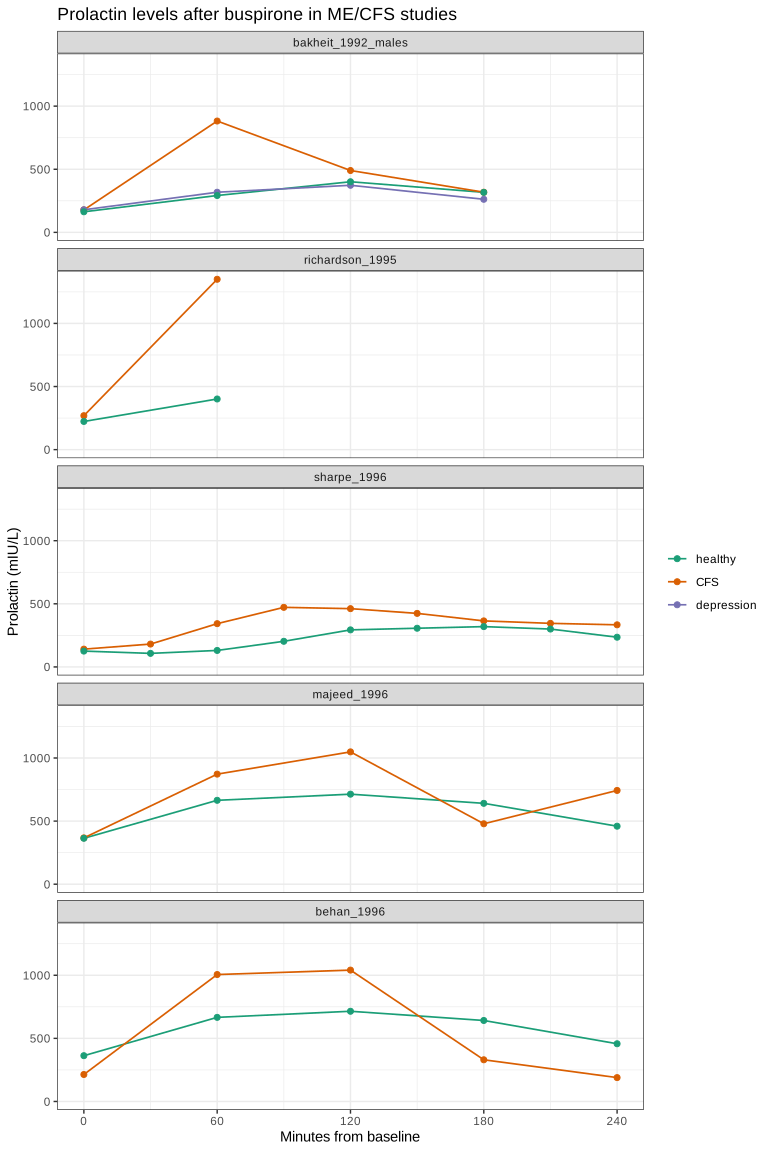
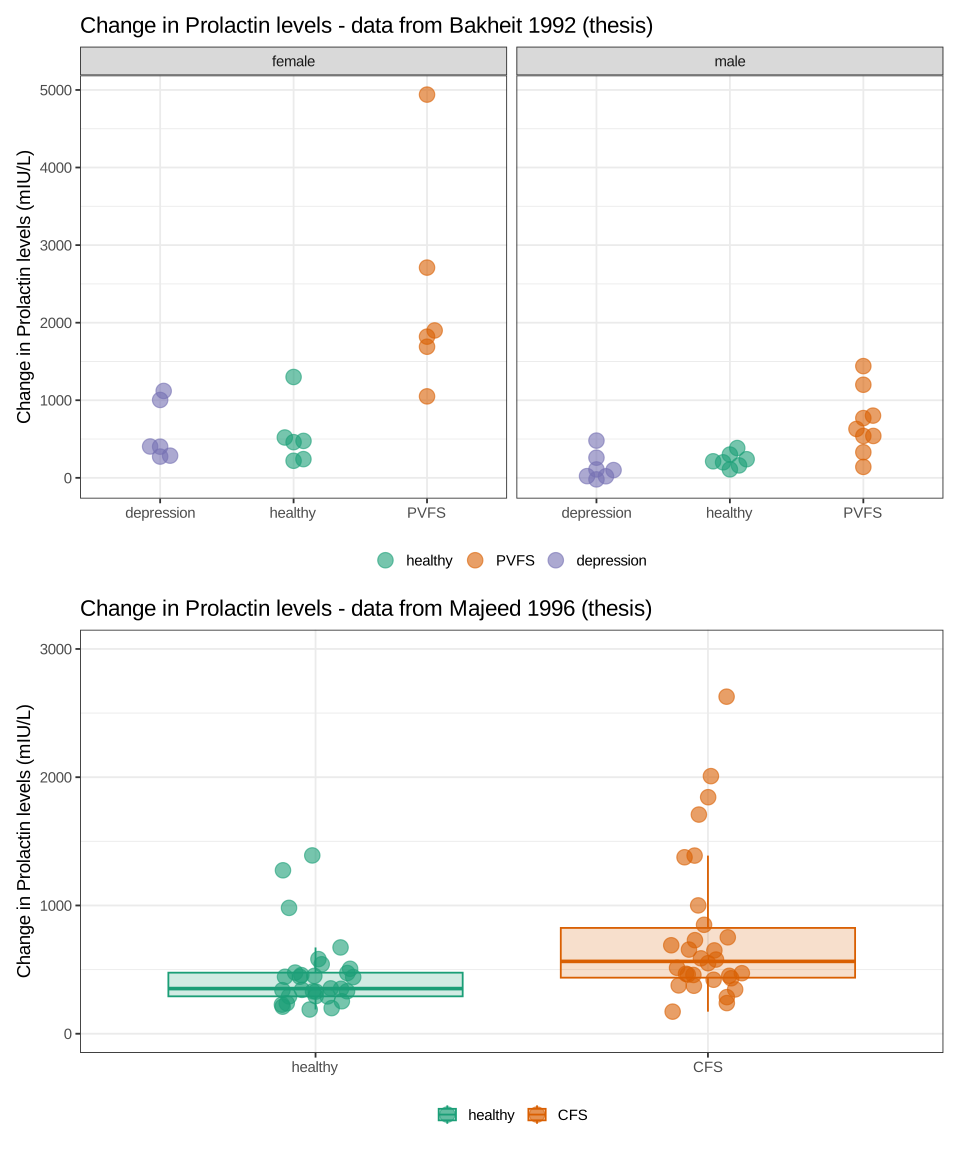
There are some obvious weaknesses in the evidence base. Most of these studies are small, with fewer than 30 ME/CFS patients. Prolactin responses also show a lot of variation and are influenced by factors such as sex, menstrual phase, time of day, and stress. There are nonetheless several arguments to take these results seriously.
- The effect is large, was found by multiple authors, and wasn’t anticipated. It didn’t match any preconceived theories. Such unexpected findings are often the most interesting ones.
- One study included controls with depression, and they didn’t have the same prolactin response as ME/CFS participants. The effect isn’t simply a result of being unwell.
- Other hormones, such as growth hormone and cortisol, didn’t show the same increased response to buspirone in ME/CFS patients. The effect seems specific to prolactin.
- Other tests that can increase prolactin, such as exercise or the insulin tolerance test, didn’t show an increased response in ME/CFS. One study included a placebo and found prolactin responses to be the same in ME/CFS patients as in healthy controls. Drugs that work similarly to buspirone, however, such as the serotonin-releasing agent d-fenfluramine, often resulted in a heightened prolactin response in ME/CFS, although the results are more inconsistent. This suggests that the prolactin response isn’t always increased in ME/CFS, only in response to specific drugs like buspirone.
- The studies used strict protocols to avoid confounding. Participants fasted overnight and were tested at the same hour of the day. Buspirone was administered 15-30 minutes after the needle was inserted to prevent stress from influencing the results. Patients stopped taking their medication four to six weeks before the test. Men and women were often analyzed separately, and females were tested at the same menstrual phase (e.g., the follicular phase).
- One study measured plasma levels of buspirone and its metabolite, 1-(2-pyrimidinyl)piperazine (1-PP), and found no group differences. This shows that the increased prolactin response isn’t due to a different breakdown process of buspirone itself.
| Study | Patients – controls | Stimulant | Effect on prolactin | Notes |
| Bakheit 1992 (Behan group) | 15 post-viral fatigue syndrome patients 40% female 13 healthy controls 13 depressed controls | 60 mg Buspirone | Males Prolactin rose 5-fold in ME/CFS, 2.5-fold in healthy controls and 2.1-fold in controls with depression Females Prolactin rose 8.2-fold in ME/CFS, 3.6-fold in healthy controls and 3.9-fold in controls with depression | Females tested during luteal phase “The buspirone caused excessive fatigue, lightheadedness, and nausea in patients but not in controls” |
| Richardson 1995 | 30 CFS/ME patients 83% female Fukuda and Oxford criteria 25 controls (family members) | 50 mg Buspirone | Prolactin rose 5-fold in ME/CFS patients compared to 1.8-fold in controls. | Single-author study “Nausea in patients as a response to buspirone was very marked in comparison to controls, and in most cases predicted the outcome of the test.” |
| Sharpe 1996 | 11 CFS patients Oxford criteria 0% female 11 controls (hospital and university staff) | 0.5 mg/kg 45mg max Buspirone | Prolactin rose 3.3-fold in ME/CFS patients compared to 2.5-fold in controls. | Growth hormone showed no significant changes Patients also had more nausea in response to buspirone but this did not correlate with prolactin response Plasma levels of buspirone and its major metabolite 1-(2-pyrimidinyl)piperazine (1-PP) were not significantly different between groups The study found “excessive variance in buspirone-induced prolactin release in both female CFS subjects and controls.” Therefore they focused on males only |
| Behan 1996 | 10 CFS patients with chronic exposure to organophosphate (OP) insecticides. 0% female 30 controls from previous study (50% female) | 60 mg Buspirone | Prolactin rose 4.9-fold in ME/CFS patients compared to 2-fold in controls. | Single-author study Behan was later found to have made errors, e.g., stating the controls were 10 males. Controls were not matched for sex Patients had lower growth hormone responses to pyridostigmine and dexamethasone |
| Majeed 1996 (Thesis) | 30 CFS patients Fukuda criteria 50% female 30 healthy controls | 60 mg Buspirone | Prolactin rose 2.9-fold in ME/CFS patients compared to 2-fold in controls. | “none of our subjects reported any feelings of nausea.” Results never published in a paper, same controls as in Behan 1996. |
| Richardson & Da Costa 1998 | 39 CFS patients Fukuda and Oxford criteria 56% female | 50 mg Buspirone | Prolactin rose 4.6-fold in males and 8.8-fold in females. | No control group. One female patient received only 20 mg because she had epilepsy and showed less prolactin increase |
| Racciatti 2001 | 14 CFS patients 5 after toxic exposure, 4 after EBV, and 5 with comorbid depression 71% female No controls | Buspirone Dosage unclear | “…an abnormal increase of prolactine levels followed the buspirone challenge test” | Data not reported No control group. |
| Sharma 2001 | 1 female CFS patient | 30 mg Buspirone | 10.6-fold increase in prolactin during illness but stable response after successful graded exercise program | Case study No control group |
Abandoned results
Why wasn’t this lead followed up? Why did the buspirone-prolactin studies stop? We can only guess, but it looks like ME/CFS studies were riding along on a wave of interest in other, better-funded fields like depression. When that interest waned, the ME/CFS field followed suit.
Another reason is that buspirone turned out to be a ‘dirty’ drug. It impacts multiple pathways, making it hard to evaluate its results. There are good reasons to believe that its effect on prolactin is mediated by dopamine, rather than serotonin pathways. Prolactin is a curious hormone that does not require a stimulus: its production is always on and regulated by signals that act like a brake on a continuous flow. The main brake mechanism is dopamine.
A third reason is that prolactin isn’t very interesting for understanding disease. It influences milk production, but its effects on other areas such as metabolism or the immune system are relatively minor. Mice lacking prolactin receptors are largely healthy apart from reproductive problems. Perhaps this made the prolactin findings less intriguing to focus on.
What does it mean?
There aren’t that many replicated findings in ME/CFS research, and the genetic evidence suggests something crucial is happening in the brains of patients. Those are two good reasons to revive the buspirone tests. They might give us another clue to the disease process behind ME/CFS.
It might, for example, point to a difference in the dopamine system in ME/CFS, as this is the main regulator of prolactin. This would be intriguing, as (preliminary) genetic findings point to the striatum and its medium spiny neurons, which are also regulated by dopamine.
Another possibility is the influence of sex hormones such as estradiol, which also influence prolactin. ME/CFS has a strong female predominance, as approximately 80% of patients are women. We still haven’t found an explanation for that notable sex difference. Perhaps the prolactin findings will give us a better view of that problem.
An increased prolactin response to brain drugs has been reported in other conditions, including irritable bowel syndrome and fibromyalgia (both frequent comorbidities of ME/CFS), but also dyspepsia and migraine. It clearly isn’t unique to ME/CFS. In depression, results pointed to a blunted rather than exaggerated prolactin response, although studies have been conflicting.

A modern replication study
There are good reasons to organize a modern replication of the buspirone-prolactin test. Because the effect is large, it would need only a small number of patients (somewhere between 10 and 30). The test would be relatively cheap to do. It would also be relatively safe although many patients did report nausea after taking buspirone.
Most of the effort of the trial would go into avoiding confounders by following the same protocol as the studies above. It would probably be easiest to focus on one sex only (either men or women tested during the same menstrual phase).
Instead of only testing buspirone, it would be interesting to test other drugs as well. Domperidone, for example, also blocks dopamine (D2) receptors but doesn’t cross the blood-brain barrier. If it has the same effect on prolactin as buspirone, we would have a better view of the key pathway involved.
If you want to learn more about the findings, data, or potential problems in the study design, feel free to join the discussion on the S4ME forum here:
https://s4me.info/threads/the-buspirone-challenge-test-clearly-distinguishes-me-cfs-patients-from-healthy-controls-why-is-it-not-being-developed-and-deployed.6421/
Isn’t it interesting that Sharpe found a physical difference in people with ME/CFS in his early years but went on to psychologize the illness? He really went against the evidence. Yet more indication of an unethical character.
The buspirone finding is potentially more important than it first appears. Its significance may lie less in prolactin itself than in the dynamic nature of the abnormal response.
ME/CFS patients did not simply exhibit chronically elevated prolactin. Rather, an apparently normal resting neuroendocrine system responded abnormally when pharmacologically challenged. That is exactly the kind of stress-revealed regulatory defect increasingly encountered in ME/CFS – basal measurements may appear relatively unremarkable, yet stimulation exposes an abnormal response amplitude, coupling or recovery behaviour.
This is directionally concordant with a disease model involving disturbed lipid-raft and membrane-microdomain organisation. Both 5-HT1A and D2 receptors implicated in the buspirone response are GPCRs whose signalling depends upon membrane cholesterol, sphingolipids, receptor localisation, G-protein coupling, internalisation and recycling. Altered raft morphology could therefore disturb not simply whether these receptors signal, but the gain, timing and termination of their signalling.
That does not mean these historical studies prove lipid-raft pathology in ME/CFS; they clearly do not. But they provide a strikingly compatible physiological phenotype – normal or near-normal baseline function followed by a mis-scaled response when the system is perturbed.
Within a virally mediated model in which persistent or intermittent viral products drive redox, cytoskeletal, sphingolipid and membrane-trafficking disturbance, such altered GPCR behaviour is precisely what might be predicted. The buspirone studies may therefore be viewed not simply as evidence of an obscure serotonergic abnormality, but as an early example of the broader loss of signalling precision and failure of adaptive regulation that may characterise ME/CFS across neuroendocrine, autonomic, immune and vascular systems.